Pair Splitting Strategies in Blackjack: How Deck Counts and Payout Ratios Influence Optimal Play
Devon Schmid · Sep 26, 2026
Pair Splitting Strategies in Blackjack: How Deck Counts and Payout Ratios Influence Optimal Play
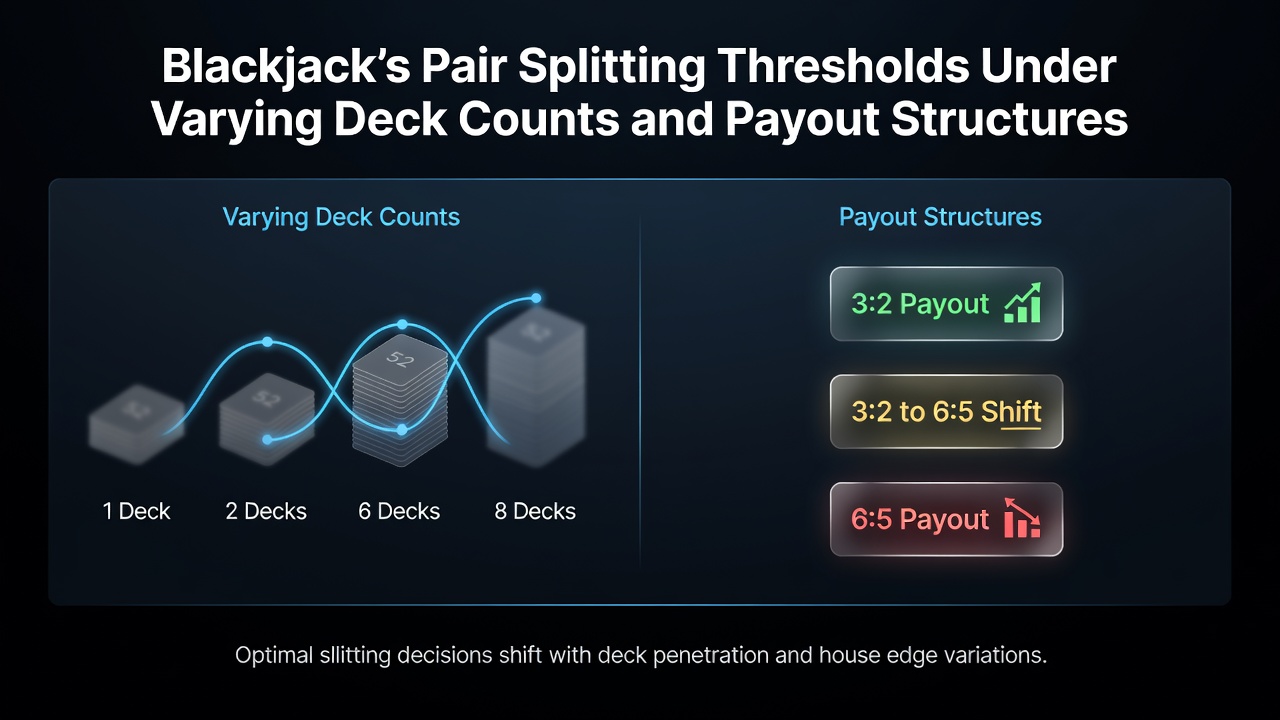
Blackjack pair splitting decisions shift based on the number of decks in play and the specific payout structure offered at the table, with researchers documenting these variations through computer simulations and probability models over decades. Players face choices when identical value cards appear, and the threshold for splitting depends on factors including dealer upcard, deck quantity, and whether the game pays 3:2 or 6:5 on natural blackjacks.
Core Mechanics of Pair Splitting Across Deck Variations
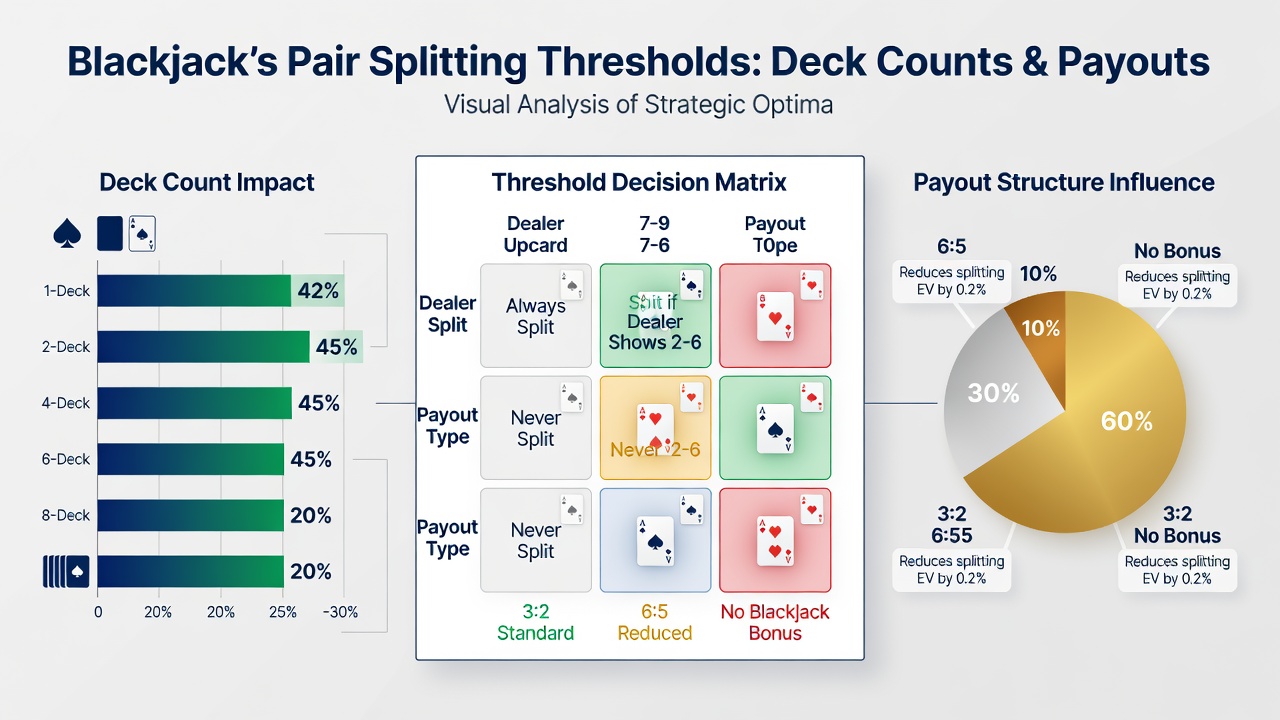
Single deck games allow more aggressive splitting thresholds because the remaining cards create higher volatility in outcomes, whereas multi-deck shoes stabilize probabilities and push certain pairs toward standing or hitting instead. Data from simulation studies shows that players split pairs of 2s and 3s against dealer 4 through 7 in single deck formats more frequently than in eight deck games, where the same pairs often warrant hitting due to reduced card removal impact. Observers note that aces and eights receive consistent splitting recommendations regardless of deck count, yet the expected value calculations tighten as decks increase because the likelihood of drawing favorable follow-up cards decreases proportionally.
Four deck and six deck configurations sit between these extremes, with splitting thresholds for pairs like 7s and 9s showing measurable differences when compared to double deck play. Research indicates that in double deck games the split decision for 9s against a dealer 8 or 9 carries positive expectation under 3:2 payouts, while eight deck games flip that same pair toward standing because the dilution of high cards reduces the advantage of creating two separate hands. Those who've examined extensive strategy charts recognize that deck penetration and reshuffle points further modify these thresholds, since deeper penetration increases the effective deck count influence during a shoe.
Payout Structures and Their Effect on Splitting Thresholds
Tables paying 6:5 on blackjacks raise the overall house edge by approximately 1.4 percent compared with 3:2 payouts, and this adjustment alters the expected value of splitting in subtle but documented ways. When the payout drops, the value of reaching twenty-one with an initial two card hand decreases, which in turn affects decisions on pairs that might otherwise push toward splitting for potential double downs or multiple blackjacks. Studies reveal that pairs of 8s remain a mandatory split even under 6:5 payouts across all deck counts, yet pairs of 4s against a dealer 5 or 6 see their splitting threshold narrow because the reduced blackjack payout lowers the overall return on creating additional hands.
Three to two payout games maintain broader splitting windows for low pairs such as 2s and 3s against weak dealer cards, while 6:5 structures compress those windows and encourage hitting in marginal situations. Figures from probability analyses demonstrate that the difference becomes more pronounced in single deck and double deck environments, where the payout change directly influences whether splitting a pair of 6s against a dealer 2 produces a net gain or loss over time. And the interaction between payout ratio and deck count creates compounding effects that strategy charts must account for separately rather than applying a single universal rule set.
Regional Regulatory Contexts and Strategy Adjustments
Regulatory frameworks in various jurisdictions require casinos to post clear rules on deck counts and payout ratios, which directly informs player strategy development. The Nevada Gaming Control Board maintains oversight of table game specifications that affect how operators present these variables, while similar bodies in other regions enforce transparency around game parameters. Players consulting updated strategy tables for September 2026 onward will encounter revisions that incorporate both traditional multi-deck environments and newer hybrid formats appearing in certain markets.
One analysis from academic researchers at the University of Nevada tracked expected value shifts across payout structures and found that splitting thresholds for pairs of 7s against dealer 8s move by several percentage points when switching from 3:2 to 6:5 in six deck shoes. Those adjustments arise because the lower payout reduces the frequency of high-value outcomes that make splitting profitable, prompting revised charts that reflect the altered mathematics without changing core principles like always splitting aces.
Practical Application in Live Play Environments
Casino floors display signage indicating deck count and payout, yet many players overlook how these details modify pair decisions during actual sessions. Take one documented case where experts compared outcomes in a double deck 3:2 game versus an eight deck 6:5 game and observed that the same pair of 3s against dealer 7 warranted splitting in the former but hitting in the latter. The difference stems from combined effects of card depletion rates and the diminished return on blackjacks, which together tip the calculation at the margin.
Strategy resources such as those published by gaming associations emphasize memorizing separate charts for each combination of decks and payouts rather than relying on generic single deck or multi-deck guides. This approach accounts for the reality that even small threshold changes accumulate over hundreds of hands, producing measurable differences in long term results according to simulation data.
Conclusion
Blackjack pair splitting thresholds respond to both deck quantity and payout structure through established probability relationships that simulations and regulatory records consistently document. Players who reference charts calibrated to specific game conditions encounter fewer marginal errors, and operators continue presenting varied formats that require these differentiated approaches. The mathematics remains stable even as new table configurations appear, providing a reliable foundation for decisions across changing environments.