The Effects of Simultaneous Hands on Risk Distribution in Single-Deck Blackjack
Devon Schröder · Sep 25, 2026
The Effects of Simultaneous Hands on Risk Distribution in Single-Deck Blackjack
Single-deck blackjack presents a distinct mathematical environment where every card removed from play carries measurable weight, and multi-hand strategies introduce new layers of dependency across outcomes. Players who engage multiple hands at once draw from the same finite pool of 52 cards, which creates correlations between individual results that single-hand play never encounters. Research from gaming mathematics programs shows these correlations reshape the overall variance of a session rather than simply multiplying exposure by the number of hands.
Core Mechanics of Single-Deck Play
Standard single-deck rules limit the total number of cards available before a reshuffle, and this constraint becomes more pronounced when participants spread bets across two or three positions. Each hand receives its own initial two cards, yet the remaining deck shrinks faster than in multi-deck formats. Data compiled by regulatory bodies such as the Nevada Gaming Control Board indicate that penetration rates in single-deck games often reach 75 percent or higher before dealers reshuffle, leaving fewer cards for later decisions when multiple hands are active.
Because the same deck supplies every hand, the composition of one hand directly influences the probabilities available to the others. A player who draws two tens on the first hand removes high-value cards that might have appeared in the second hand, altering the expected value calculations for subsequent plays. Statisticians tracking these interactions note that the covariance between hands rises sharply compared with independent multi-deck scenarios.
How Multi-Hand Spreads Modify Variance
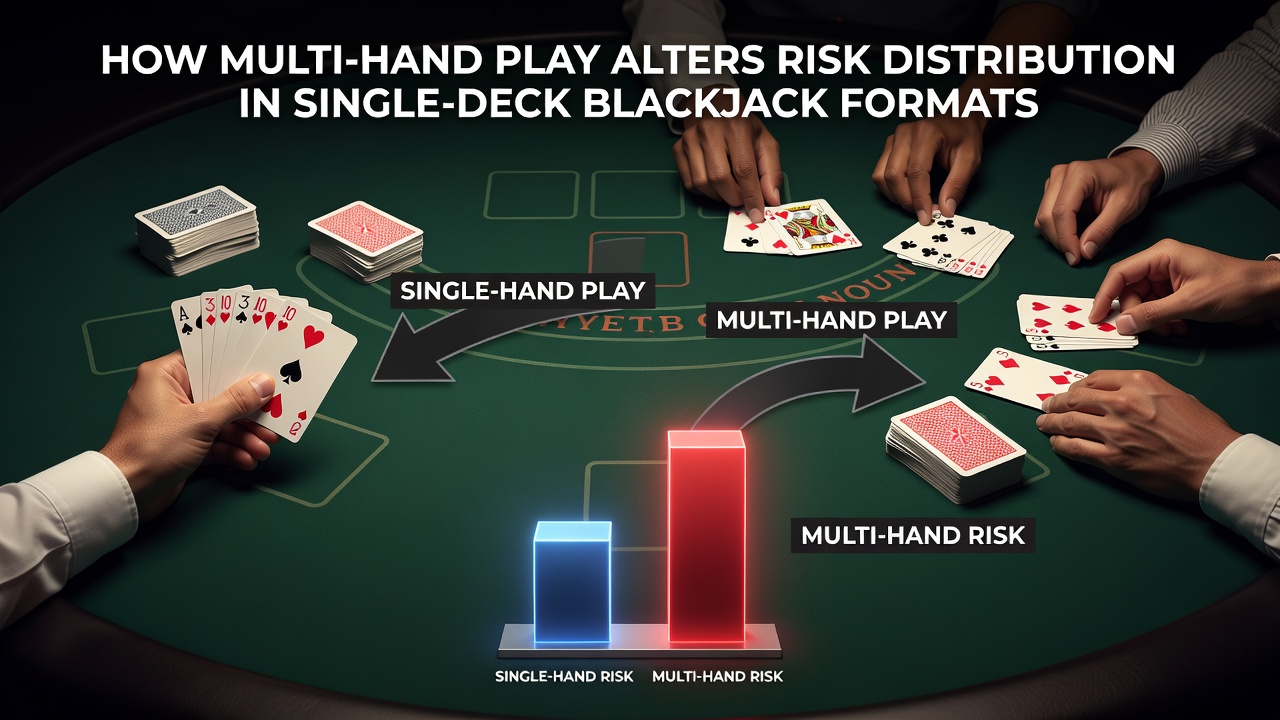
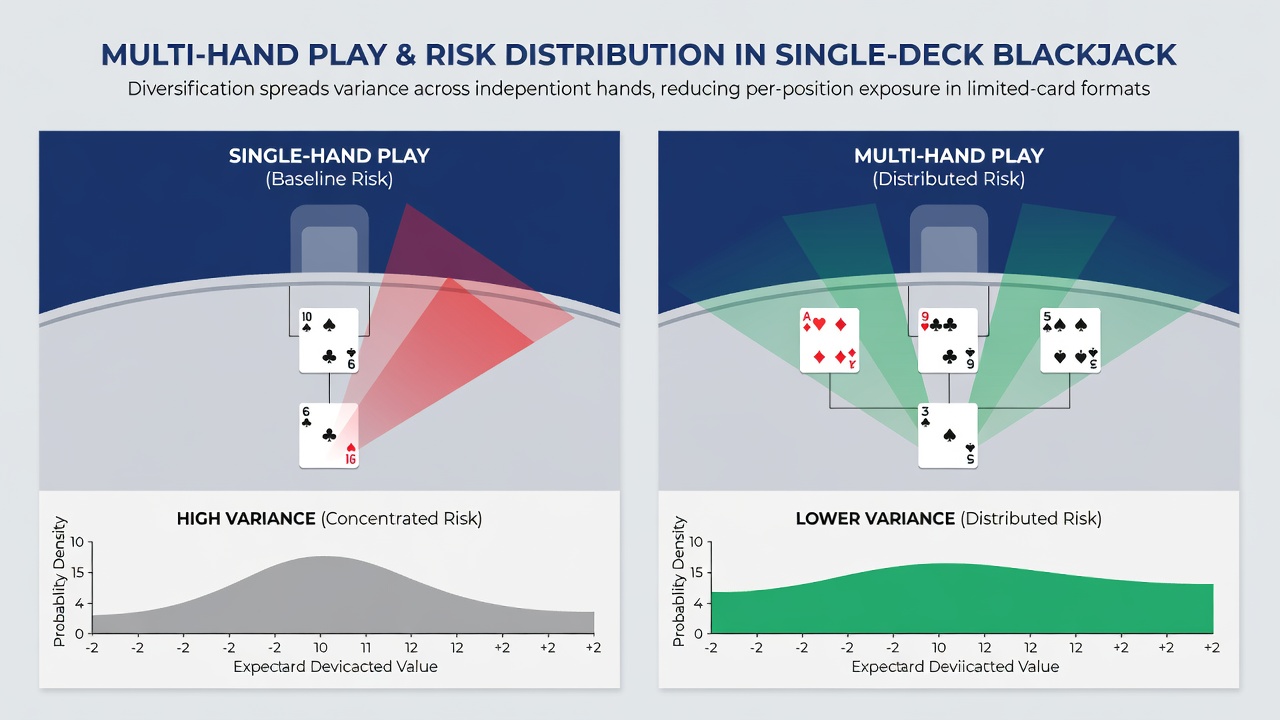
Variance measures the dispersion of results around the expected return, and multi-hand play in single-deck conditions compresses or expands that dispersion depending on the number of simultaneous positions. When two hands share the deck, positive outcomes on one hand frequently coincide with neutral or negative results on the other, which dampens the extreme swings that appear in isolated single-hand sessions. Studies published in applied probability journals demonstrate that the standard deviation per hand decreases as the number of correlated hands increases, yet the total bankroll fluctuation widens because more money sits on the table per round.
Consider a participant who plays two hands of equal size. The combined return per round exhibits lower per-hand volatility but higher absolute exposure, shifting the risk profile toward steadier incremental losses or gains rather than dramatic individual outcomes. Observers who have examined session logs from single-deck tables report that players using multi-hand spreads encounter fewer instances of total ruin in short samples, although cumulative drawdowns can still reach substantial levels over extended play.
Statistical Patterns Observed in Practice
Simulation models built from millions of single-deck rounds reveal that three-hand spreads produce a measurable reduction in the frequency of large positive or negative deviations per round compared with one-hand play. The correlation coefficient between paired hands typically ranges between 0.15 and 0.35 depending on penetration and rule variations, according to analyses conducted by independent research groups. This moderate positive correlation means that streaks of wins or losses tend to affect multiple hands together, concentrating risk into fewer but more impactful rounds.
Bankroll requirements adjust accordingly. A player who maintains a fixed unit size across two hands needs a larger reserve to withstand the increased total bet per round, even though the percentage volatility declines. Figures released by the Canadian Gaming Association highlight that operators in jurisdictions permitting single-deck games often adjust table minimums when multi-hand options appear, reflecting the altered risk distribution for both participants and the house.
Practical Implications for Session Management
Dealers and floor supervisors at single-deck tables monitor multi-hand action closely because the faster card consumption changes the timing of reshuffles. In regions where regulations require specific penetration thresholds, the presence of additional hands can trigger earlier reshuffles, which in turn resets the composition before extreme counts develop. Reports from the Australian Gambling Research Centre note that such procedural adjustments maintain house margins within narrow bands despite the mathematical shifts introduced by multi-hand spreads.
Those who track card counts in single-deck environments must recalibrate their betting ramps when spreading to multiple hands. The true count applies across all positions simultaneously, yet teh removal of cards for one hand modifies the remaining deck for the others in real time. This interdependence requires updated strategy indices that account for the joint distribution rather than treating each hand as an isolated decision point.
Conclusion
Multi-hand play in single-deck blackjack redistributes risk by introducing dependence among outcomes drawn from the same card pool. Variance per hand declines while total exposure per round rises, producing session profiles that differ measurably from single-hand formats. Regulatory data and simulation studies confirm these patterns hold across common rule sets, and participants who adjust bankroll sizing and count strategies accordingly operate within the documented statistical framework of the game.