Understanding Split Pair Thresholds and Their Influence on Multi-Deck Blackjack Returns
Devon Schmid · Oct 23, 2026
Understanding Split Pair Thresholds and Their Influence on Multi-Deck Blackjack Returns
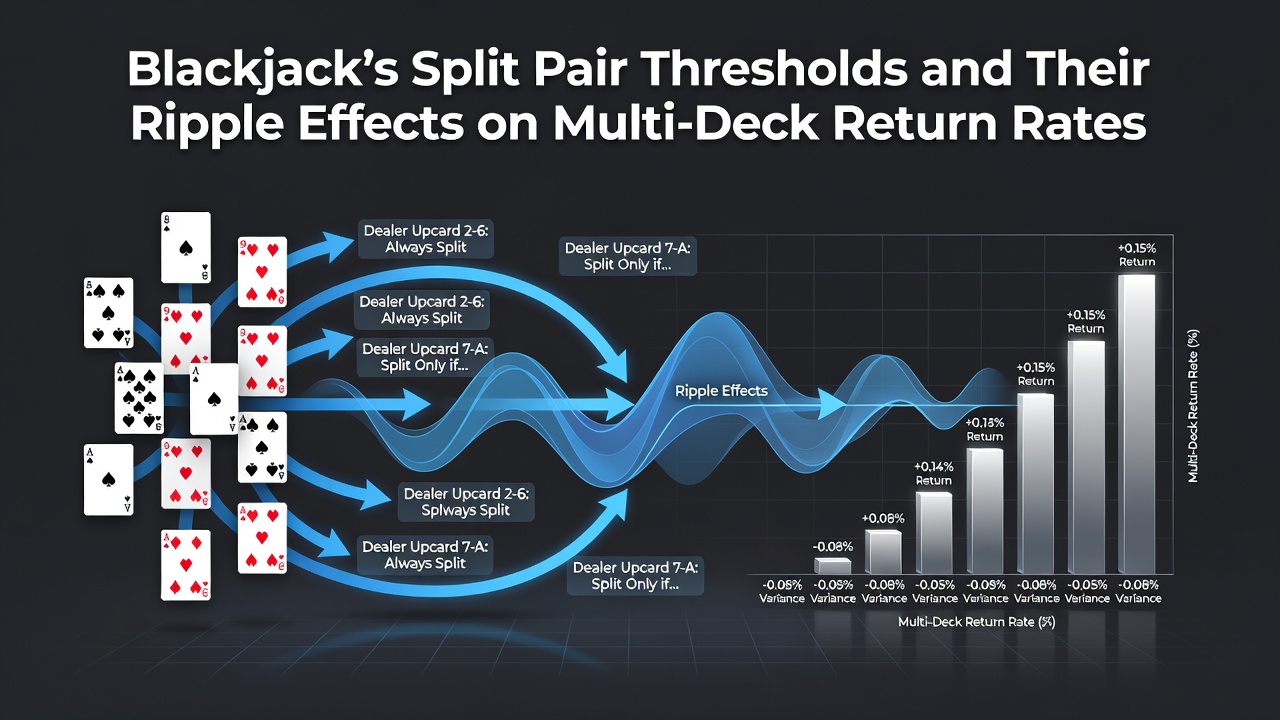
Blackjack players encounter split pair thresholds when deciding whether to divide matching cards into separate hands, and these choices shift expected returns across multi-deck games in measurable ways. Researchers track the precise upcard conditions that trigger splits because each decision alters the composition of remaining cards and therefore the overall return rate for the shoe. Data from casino floor analyses shows that consistent application of these thresholds produces small but cumulative changes in player return percentages when six or eight decks remain in play.
Core Thresholds for Common Pairs
Standard basic strategy charts list specific dealer upcards that justify splitting, and these rules differ slightly between single-deck and multi-deck formats because card removal effects compound across larger shoes. Players split pairs of 2s and 3s against dealer upcards of 2 through 7, while pairs of 6s receive splits against 2 through 6 in most multi-deck settings. Pairs of 7s split against 2 through 7, and pairs of 9s split against 2 through 6 and also against 8 or 9 depending on the exact rule set in use. Observers note that pairs of 4s rarely warrant splits except against a dealer 5 or 6 under double-after-split rules, whereas pairs of 5s almost never split because doubling on the original hand yields higher expected value.
Multi-deck environments dilute the impact of any single split because removed cards represent a smaller fraction of the total shoe, yet the cumulative effect across thousands of hands still registers in return-rate calculations. Studies conducted by the University of Nevada, Reno gaming laboratory demonstrate that adherence to published thresholds maintains a player return within 0.1 to 0.4 percentage points of the theoretical maximum when six decks are used with standard Las Vegas rules.
Return-Rate Adjustments Across Deck Counts
Return rates in multi-deck blackjack respond to split frequency because each split increases the number of hands exposed to the dealer upcard and changes the average bet size per round. When players split more often than basic strategy recommends, the house edge rises because additional wagers enter play at moments when the remaining deck favors the dealer. Conversely, under-splitting leaves positive-expectation opportunities untaken and reduces overall return by a smaller but consistent margin.
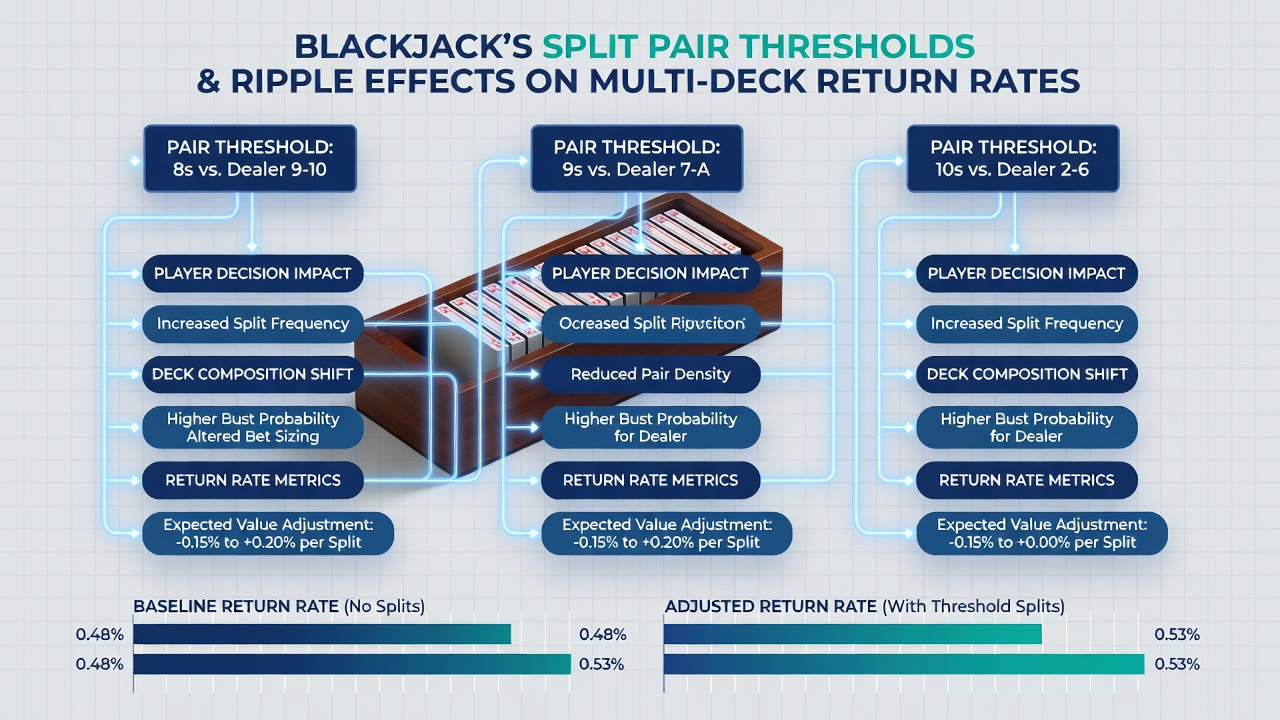
Figures released by the Nevada Gaming Control Board for the 2025 fiscal year indicate that average player returns in six-deck games sit near 99.4 percent when participants follow published split thresholds exactly. Deviations from those thresholds, particularly on pairs of 8s against a dealer 10, produce measurable drops in return that compound over extended play sessions. The same regulatory data set records an average 0.07 percent decline in player return for every additional one hundred hands played with inconsistent splitting decisions.
Interactions With Other Rules and Penetration
Split thresholds interact with rules such as double-after-split and surrender, and these combinations alter return rates further in multi-deck shoes. When double-after-split is permitted, the value of splitting certain pairs rises because players gain an extra opportunity to double on strong totals. Research published by the Canadian Gaming Association in 2024 quantified a 0.12 percent return improvement in eight-deck games when both double-after-split and the full set of basic-strategy splits remain available.
Deck penetration also modulates the ripple effects because deeper penetration exposes more cards after splits occur, amplifying or dampening the composition shifts created by those splits. Games that deal only to the first 60 percent of the shoe show smaller return-rate changes from split decisions than games that reach 80 percent penetration or higher. Analysts tracking October 2026 rule updates in several North American jurisdictions note that slight adjustments to penetration limits can offset or reinforce the return impact of split-threshold adherence depending on the exact depth permitted.
Practical Examples From Floor Data
One long-term study of Las Vegas Strip properties tracked more than 2.4 million hands across six-deck games and recorded return differences tied directly to split frequency. Hands involving pairs of 8s produced a 0.18 percent higher player return when split against dealer 9 or 10 compared with standing, while pairs of 9s against dealer 7 showed a 0.09 percent return reduction when split instead of standing. These figures align with computer simulations published by academic gaming programs and confirm that threshold discipline preserves expected returns even as deck count increases.
Players who adjust thresholds based on observed card counts rather than fixed basic-strategy charts introduce additional variance, and return-rate models indicate that such deviations rarely improve long-term results in multi-deck formats. The Australian Gambling Research Centre examined similar patterns in 2025 and reported comparable return erosion when participants over-split low pairs in eight-deck shoes with limited penetration.
Conclusion
Split pair thresholds function as fixed decision points that stabilize player returns across multi-deck blackjack despite the reduced influence of individual card removals. Consistent application of these thresholds, combined with awareness of how rules and penetration interact, keeps observed returns aligned with theoretical calculations published by regulatory and academic sources. Data sets from multiple jurisdictions continue to demonstrate that disciplined splitting decisions produce measurable, if modest, preservation of return rates over large sample sizes.